
- Services & Solutions
Tackling Digital Tech Gaps, Seamlessly

- Industries
Industries We Serve: Real Impact, Real Businesses

- Resources
Global Talent, Local Impact: Offshore Insights


The digital world of 2026 is like a planet-sized neural engine. Every click, swipe, and search leaves behind data trails shaped by geography, behavior, and intent. As AI-powered search interfaces like ChatGPT Search, Gemini Assist, Perplexity, and new conversational browsers become more popular, GEO (Generative Engine Optimization) has become the lighthouse that guides brands through the rising tide.
SEO helps brands move up the search results, but GEO helps them become the answer itself. And as AI engines become more like advisors that take context into account, your visibility will depend more and more on how well your content fits with geographic signals, hyper-local patterns, real-time user needs, and the new rules for AI-generated responses.
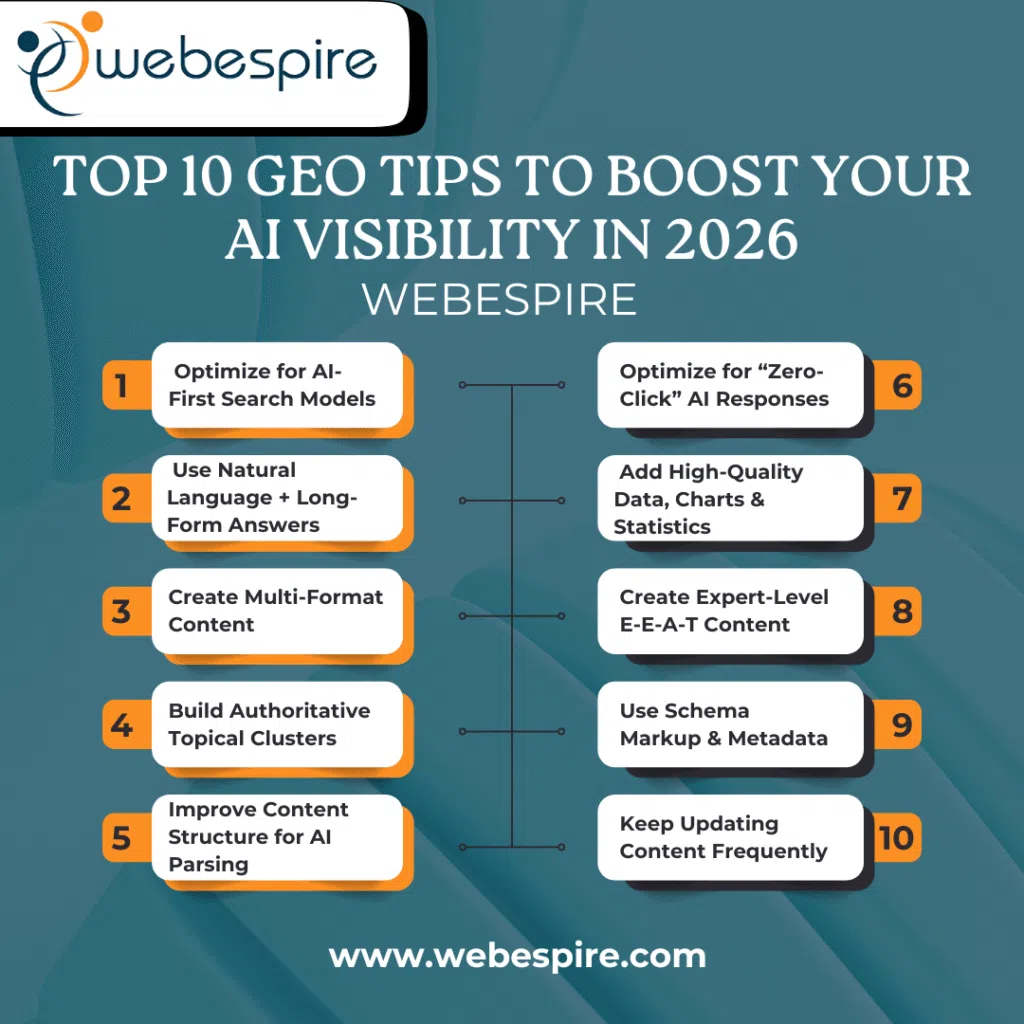
We help businesses at Webespire Consulting not only get ready for the future, but also feel confident about it. This is your complete guide to the Top 10 GEO Tips for Making Your AI More Visible in 2026. It’s for brands that want to have a bigger presence in Canada, the UK, the USA, India, Europe, and around the world.
AI engines don’t “search” like we do.
They make things work together.
They read, compress, check for credibility, and then come up with answers.
GEO makes sure that:
In other words, if SEO is about being discovered, GEO is about being chosen.
AI engines like things to be clear.
Clearly organize your content by location, service, and purpose.
For instance:
This gives AI engines clear anchors that match the way people search in different areas.
How Webespire can help:
We make GEO-optimized landing pages that have schema, conversational cues, and location markers. These pages are perfect for AI extraction.
AI engines often pull text that looks like direct answers.
Add phrases like:
These work like magnets for generative engines.
AI engines give priority to data that can be cited and backed up with evidence.
How to use:
AI engines see you as a reliable source of citations when your content has data that can be checked.
Structured data is now the main part of GEO.
Use:
Schema is a big part of how the 2026 AI models choose which sources to use as “default answers.”
AI engines look for proof that your business really does work where you say it does.
These make things more real, which is now a big factor in rankings.
These are long-form resources that are best for generative extraction.
AI engines like content that already looks like an answer.
38–44% of AI searches will be voice-activated by 2026.
Voice queries are not the same:
Make sure to use these patterns in your writing.
AI models work with pictures.
This makes it easier for AI to understand your content.
Name, Address, and Phone (NAP) consistency now has a bigger effect on GEO ranking than local SEO.
Check to see:
all have the same geographic identity.
AI engines trust mentions of brands, especially when they are linked to a location.
You can help:
Every mention with a GEO tag makes your AI visibility footprint bigger.
This is a 2026 power technique.
Create a micro-library containing:
AI engines detect clustered evidence and rank such brands higher for reliability.
Here is an example of a paragraph that shows how AI engines like structured, local content:
For example, if you’re a startup in Toronto making an AI-powered mobile app, the average cost of development in 2026 will be between $35,000 and $120,000, depending on things like cloud integration, custom UX, and fine-tuning the AI model. For Canadian businesses, the fastest way to get to market is to use a hybrid development model with a Canadian product lead and an Indian engineering team working from abroad. This cuts costs by 42% while keeping quality high. Our Toronto + India model at Webespire Consulting is perfect for this.
This style is great for GEO visibility because it is structured, local, credible, and conversational.
Be the brand that AI suggests
Show up in responses from ChatGPT Search, Gemini, Claude, Alexa, and hybrid AI browsers.
✓ Take over hyper-local intent
Get high rankings for cities, regions, neighborhoods, and small searches.
✓ Cut down on marketing costs
AI-driven visibility means you don’t have to rely on paid ads as much.
✓ Gain trust and respect
Verified and locally based sources are very important to AI engines.
✓ Easily grow into new markets around the world
One content strategy leads to AI visibility in many areas.
✓ Make sure your brand is ready for AI-first browsing in the future.
GEO is not a fad.
It’s the new way to act online.
Ans: GEO stands for Generative Engine Optimization, the process of optimizing content for AI engines that generate answers instead of displaying search pages.
Ans: SEO focuses on rankings.
GEO focuses on selection—being chosen as the source behind AI-generated answers.
Ans: Yes—especially for IT services, ecommerce, healthcare, education, and SaaS, where AI-generated search volume is highest.
Ans: Expect improvements within 30–90 days, faster with structured data and location authority.
Ans: Absolutely, We craft, implement, and maintain GEO-optimized content, schema, technical architecture, and location-specific visibility strategies.
Your customers in Canada, UK, USA, India, Europe, and beyond aren’t “searching” anymore—they’re asking.
Make sure AI engines answer with your brand.
👉 Claim your FREE 15-minute consultation today and explore how we can design a website that drives growth and results.
📩 Don’t wait—Book your session now!
🚀 Boost your GEO Visibility for 2026 with Webespire Consulting
📧 Email: info@webespire.com
🌐 Website: www.webespire.com
Let’s build your AI-first future—one optimized answer at a time.



01 Comment
Sandeep,
12 December, 2025This is best idea for GEO and very helpfull for me.
Thanks Webespire