
- Services & Solutions
Tackling Digital Tech Gaps, Seamlessly

- Industries
Industries We Serve: Real Impact, Real Businesses

- Resources
Global Talent, Local Impact: Offshore Insights



Web development in 2026 is more than just making websites. It’s also about making web experiences that can grow, work well, and last into the future. Businesses today need apps that are quick, adaptable, safe, and simple to grow. JavaScript-based full-stack technologies like MERN Stack and MEAN Stack are still at the top of the list here.
Over the years, MERN Stack and MEAN Stack have changed a lot and have been used to make everything from MVPs to apps for big businesses. The question that still needs to be answered is: In 2026, is MERN Stack better than MEAN Stack, or the other way around?
This full guide from Webespire Consulting will show you how to do the following:
Let’s get started.
Before comparing them, it’s important to understand what these stacks are built on.
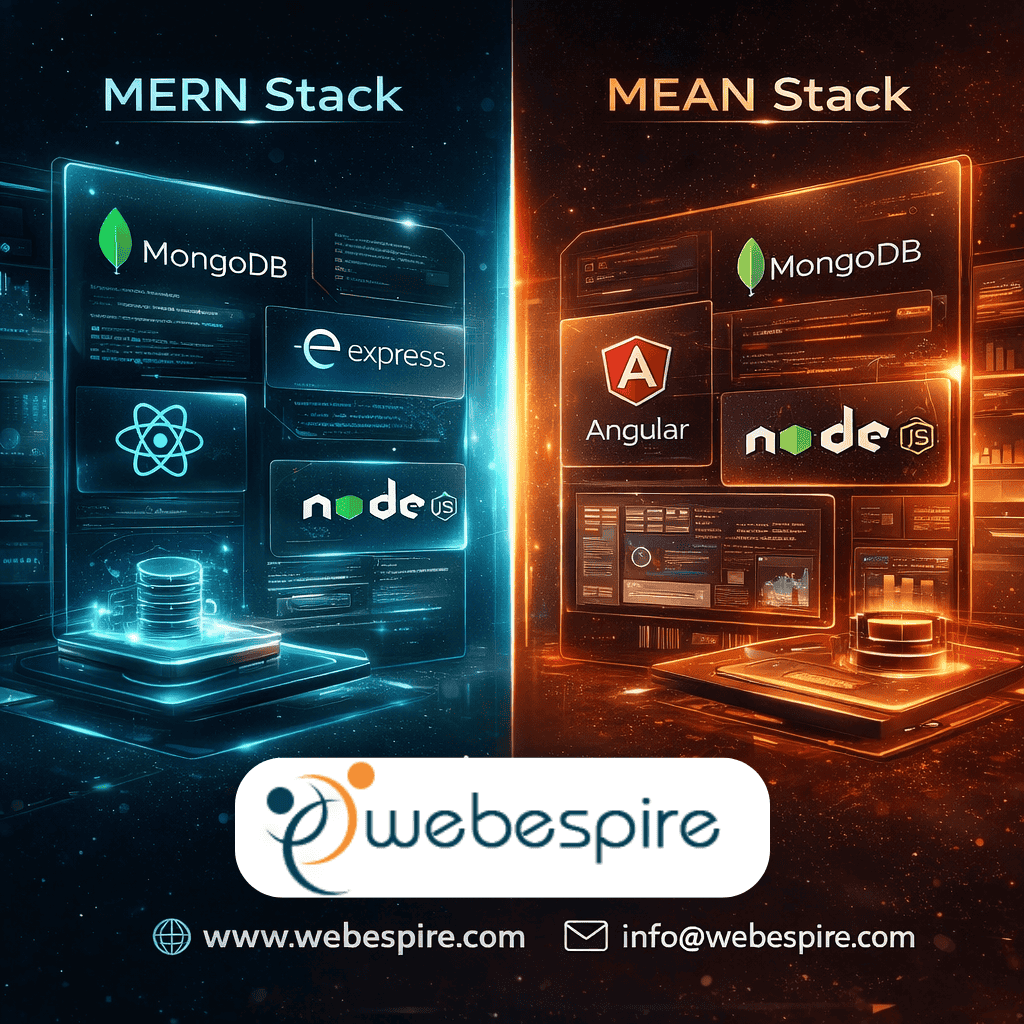
MERN Stack is a full-stack JavaScript framework consisting of:
MERN allows developers to use JavaScript across the entire development lifecycle, making development faster and more consistent.
MEAN Stack is another JavaScript-based full-stack solution, which includes:
The core difference lies in the frontend layer: React vs Angular.
While both stacks share similarities, their architectural philosophy and development experience differ.
👉 In 2026, businesses prioritizing custom UI and faster iterations lean toward MERN, while those needing strict architecture often prefer MEAN.
Both stacks deliver excellent performance, but MERN often feels faster on the frontend due to React’s virtual DOM and efficient rendering.
Technology never stands still—and neither do these stacks.
MERN Stack shines in projects that demand speed, flexibility, and rich UI.
Businesses working with Webespire Consulting often choose MERN when they want faster go-to-market timelines and highly interactive user experiences.
MEAN Stack is best suited for applications requiring long-term stability and strict architecture.
If consistency, scalability, and structured workflows are top priorities, MEAN Stack remains a solid choice in 2026.
The future looks extremely promising for MERN Stack.
As businesses shift toward modern, user-centric applications, MERN Stack continues to be a preferred technology for innovation-driven companies.
MEAN Stack is not going anywhere—it’s evolving.
MEAN Stack will continue to thrive in regulated industries and enterprise environments where structure and stability matter most.
There is no one-size-fits-all answer.
At Webespire Consulting, we analyze your business goals, budget, scalability needs, and timeline before recommending the right stack.
Not necessarily. MERN Stack is better for flexibility and UI-rich applications, while MEAN Stack excels in structured, enterprise-level projects.
Both stacks are future-proof. MERN is more popular among startups, while MEAN remains strong in enterprise environments.
Yes, when built with proper architecture, MERN Stack can scale efficiently for large applications.
MERN Stack often reduces development time, making it more cost-effective for startups and mid-sized businesses.
Absolutely. Webespire Consulting provides expert consultation and development services tailored to your business needs.
Both the MERN stack and the MEAN stack are still excellent options for full-stack web development in 2026. The right choice depends on your business goals, project difficulty, and vision for the future.
Whether you’re a startup seeking to quickly generate new ideas or a large company planning a digital transformation for future growth, selecting the right technology stack can significantly impact your success.
Looking to build a high-performance web application using MERN or MEAN stack?
👉 Webespire Consulting specializes in modern, scalable, and future-ready web development solutions.
Our experts help you choose the right stack, design robust architecture, and deliver results that drive growth.
👉 Let’s turn your idea into a powerful digital solution.
📩 Email: info@webespire.com
🌐 Website: www.webespire.com